Kyocera Ceramic Knives – How Are They Made
We take you around the world to show you how they do it. Japan has long been the spiritual home of the swordsmith and since the time of the samurai, they’ve been the undisputed masters of the steel blade. Here on the southwest island of Kyushu a company is breaking with tradition and has started producing a revolutionary new type of super-sharp blade made not from steel but a kind of ceramic. So how do they do it, sushi chefs, our modern masters at wielding a blade, and up until recently these kitchens would have been filled with knives made from stainless steel but now there’s a new kid on the chopping block.
Not only is it harder than steel it never rusts doesn’t stain and is almost impossible to blunt making it ideal for producing the wafer-thin slices of fish necessary for perfect sushi. To make these extraordinary knives they use a new high-tech ceramic which is second only to Diamond in terms of hardness. The trouble is just like diamonds to get the ceramic material you must travel to the ends of the earth. Well, not quite the ends of the earth our journey has taken us to Western Australia on the outskirts of Perth where we find the Dardan up mine and geologist Dr. Lorraine Crockford is heading out for another day of prospecting.
She’s not looking for gold or silver but rather areas rich in all it is a bit similar to gold prospecting. I’m looking for how much black stuff I can see in the pan it’s this black sand that contains a rare colourless mineral called zircon. Zircon is the key ingredient needed to make ceramic knives so once Lorraine has decided where they should mine it’s time for the heavy diggers to move in and start transferring the earth to an army of refining machines. First, a giant vibrating table shakes the largest pieces of rock to the surface next this huge drum spins the material with water to sieve out any remaining pieces of stone.
The remaining mineral-rich sand is then pumped to the so-called wet plant it looks like something from an old sci-fi b-movie but these strange giant corkscrews perform the same function as a prospectus pan only on an industrial scale. As the mix spins through these spirals lighter sands collect on the outside and are discarded while heavier minerals stay in the middle and are collected the result is a thick black sludge containing a mix of different minerals these are separated using magnetic and electrostatic machines. A wettable and finally one last shake that comes out is almost a hundred per cent pure zircon ready to be shipped around the world.
Zircon is sent to China for refinement into zirconia, then arrives in Sendai at Kyocera, a leading Kyocera ceramic knifes manufacturer. The zirconia powder is moulded into fragile knife-shaped blanks using a 300-ton high-pressure press, which is then hardened by firing in a kiln at 1,400 degrees Celsius for 48 hours, transforming them into virtually unbreakable ceramic blades. Although these blades are harder than steel, they are initially blunt and not ready for use.
The zircon goes to China where it’s further refined into zirconia before it arrives here in the ancient Japanese city of Sendai this plant belongs to Kyocera the world’s leading manufacturer of ceramic knives. They begin by molding the zirconia powder into the right shape using a high-pressure press producing a force of almost 300 tons. The press compacts the powder into a knife-shaped blank these blanks are extremely fragile and can be shattered by the slightest knock.
So like all ceramics, they must be hardened by firing. The temperature inside this kiln reaches 1,400 degrees Celsius and after 48 hours of fierce baking, the soft powder blanks are transformed into virtually unbreakable ceramic. The result is an extremely hard blade which is tougher even than the strongest steel equivalent but you won’t be tucking into your sushi with it just yet because these knives are as blunt as a bar of soap.
So to add the all-important cutting edge Kyocera has turned to the skills of a traditional craftsman. Meet the master here in a small workshop on the edge of the town the master and his assistants work by hand to sharpen the Kyocera ceramic knives. It’s a job that requires a steady hand and intense concentration using a spinning wheel coated in diamond dust they slowly grind away the hardened zirconia to create a razor-sharp edge.
My favourite thing about the job is being able to go home at night knowing I’ve made the perfect knife. Even though I’m the master there’s a lifetime of learning ahead before I ever consider myself the true master. Anyone squeamish should now look away and if any children are watching please do not try this next bit at home in true maniacal samurai style the master tests the razor sharpness of the knives on himself. Presumably, he knows he’s got the perfect knife when his thumb drops off as the master and his team bandage their hands the knives are returned to the factory where a laser is used to etch the Kyocera ceramic knives trademark.
The Japanese authorities realise that super-sharp Kyocera ceramic knives pose a potential security threat since terrorists would be able to sneak them past the metal detectors at airports. To prevent this metal has been mixed with the ceramic enough to set off an alarm and two more checks to see if the blade is as tough as it should be and to see if you can cut through a telephone directory should the need arise which is all very well but will the blade cut the mustard? With a master sushi chef back at the restaurant, another batch of raw fish is nearing completion in the hands of the sushi master the Kyocera ceramic knife deftly shaves the wafer-thin slices of fish, and what’s more thanks to its chemically inert blade it doesn’t absorb any odours from the various fish oils keeping the taste pure.
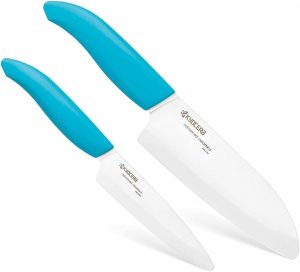
See more about Kyocera Ceramic Knives: Best Ceramic Knives Review